|
There's a second unsettling scenario for the MSX invasion.
In 1946 when Nelson was calling for the planting of Japanese oysters, the old Ghost Fleet of mothballed Navy ships was bringing more ships into the James River every week. With the end of World War II, hundreds of ships were arriving in Chesapeake Bay and steaming upriver for long-term anchorage. They were sailing back from Europe — and from Japan.
In 1950, the James River Reserve Fleet hit its historic high with 800 ships lashed together in groups of 12 to 30 ships, a flotilla that stretched miles up the river. Between 1950 and 1954, many of those ships were reactivated to carry troops off to the Korean War — and bring them home again. By 1957 MSX began showing up in oysters.
The timing of all that shipping traffic and the sudden onslaught of MSX a few years later is, at the least, suggestive. Ships can carry MSX in various ways. Oysters can attach to their hulls, says Ford, and MSX and perhaps an alternative host could be hitchhiking here in ballast water. If ships dump their ballast water or their bilge water in the Bay, they could be releasing those MSX or its hosts into the Bay.
"Let's look at this scenario," says Canzonier who finds this option more plausible. "Suppose we had MSX in the Chesapeake Bay for a number of years being introduced by the Naval fleet coming from Korea. And it just never flared up because conditions were not quite right." MSX may have invaded the Chesapeake first and then shipped north to Delaware with James River seed oysters, says Canzonier, now president of the New Jersey Aquaculture Association.
"Perhaps in the mid-1950s, the environmental conditions were more
appropriate in Delaware Bay or the alternate host was present in sufficient number," he says Canzonier. "And it caught fire here before it caught fire in Chesapeake Bay."
Working just south of the Ghost Fleet, Burreson and his crew finish culling through their last dredge load of James River oysters. The biologist leans over and peers at his one bucket of live oysters, then with a sweep of his arm shoves all the shells and dead oysters overboard.
"It's possible that MSX came in ballast water," says Burreson, glancing at the ships to his north. "Some of these ships here were probably involved in moving troops from Korea. It could have happened during that period. And there are some cases where ships came from Korea into Delaware Bay and dumped ballast water there."
Naval ships, of course, were only part of the shipping traffic that was steaming through the Chesapeake and Delaware during the 1950s carrying cargo and ballast water and perhaps MSX from Korea and Japan. As the size and speed of commercial tankers and freighters have increased in recent years, ballast water has emerged as a major research focus for invasion ecologists, who suspect numerous organisms are offloading in our coastal waters. The ballast water research team at the Smithsonian Estuarine Research Center estimates more than 150 invasive species are now surviving in the Chesapeake. The Chinese mitten crab may be the latest arrival.
Who started the MSX invasion of the Chesapeake?
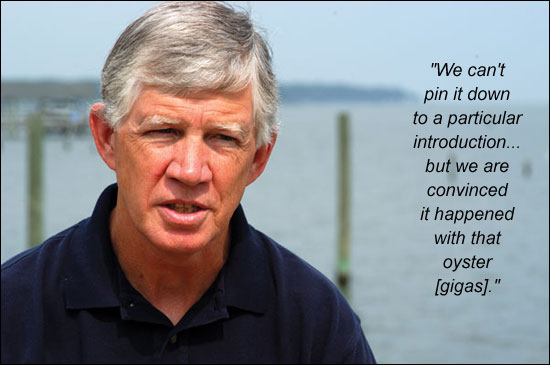
The interim verdict: the MSX invasion may have begun with an experiment by an oyster scientist, with a planting by a grower, with a ballast water release by a ship — or with all of the above in several places on several dates. The jury is still out, the history still open to debate. "We can't pin it down to a particular introduction in a particular place," says Burreson, "but we are convinced it happened with that oyster [gigas]."
The future is also open to debate. With native oysters now depleted, thanks in part to a Japanese oyster parasite, some scientists and growers and politicians want to rebuild the commercial seafood industry and perhaps restore the Bay's ecology by planting Chinese oysters, Crassostrea ariakensis, in the Chesapeake. It's a prospect that stirs considerable debate in the scientific community, yet a prospect that Burreson, surprisingly enough, does not oppose.
There may be lessons in his research, but keeping out ariakensis is not one of them, at least for Burreson. "People are now using this [finding] as an argument against introducing ariakensis," says Burreson before offering a different, more upbeat reading of his own research. "It shows what can go wrong," he says, "when you don't do things right."
Contemporary scientists, in his opinion, are doing things right: they are keeping ariakensis oysters isolated in hatcheries, then spawning sterile offspring, and only then trying test plantings in the Bay. If this approach had been followed with Japanese oysters, he says, MSX would never have invaded these waters.
Burreson, like Thurlow Nelson 50 years ago, is optimistic that science may yet find or build a better oyster for the Bay. Through patient crossbreeding, researchers at Rutgers and VIMS have developed several strains of disease-resistant native oysters for use by the aquaculture industry. And Mother Nature all by herself, through natural selection, may build a native, disease-tolerant oyster for the Bay. Oysters that survive MSX tend to pass on their resistance to their offspring until, over the long generations, an MSX-tolerant oyster emerges. That process has already worked in Delaware Bay, according to Susan Ford, and it may one day work in the Chesapeake.
Some mysteries remain — and some ironies. Burreson's work with MSX continues because, even after half a century, key questions about the disease have never been solved. The other life stages of MSX remain unknown, as does the alternate host. Burreson and his team keep searching for the DNA of MSX in dozens of species, hoping to find the host species which carries MSX around the Bay. "It's like searching for a needle in a haystack," he says. "I hope somebody cracks this before I die."
Thurlow Nelson, the man with high hopes for Japanese oysters, died long before any MSX mysteries were solved. On September 12, 1960, he left his summer cottage near Cape May as Hurricane Donna swept up the coast. Hoping to tie up his rowboat, he waded out into Delaware Bay and drowned there in the rough waters of the rising storm.
The biologists he mentored decided to honor his memory in the name of a new species they called Minchinia nelsoni — and, later, Haplosporidium nelsoni — the scientific term for the parasite Nelson knew only as MSX.
|